


Air curtains: reducing energy losses and improving indoor comfort
An air curtain acts as an invisible barrier separating different indoor and outdoor climate zones. The technology reduces uncontrolled air exchange through open entrances, helping to keep heat inside the building in winter and conditioned air inside in summer. Teddington combines more than 50 years of experience in air curtain technology with solutions designed to address today’s energy requirements, helping to reduce energy losses and maintain more stable indoor conditions.
How does an air curtain work?
The principle is based on a controlled airflow. Indoor air is drawn into the unit through an air intake grille and accelerated by powerful fans. It is then discharged downwards through specially designed nozzles as a precisely directed air stream.
A key factor in the effectiveness of an air curtain is the air discharge system. Conventional systems with air guide vanes can create turbulence in the airflow, reducing the effectiveness of the air barrier. Teddington’s patented CONVERGO® pressure chamber nozzle system directs and concentrates the airflow precisely. This allows a stable air barrier to be created with a lower air volume than conventional air curtain systems with air guide vanes.
Different types of air curtain are available depending on the building and application requirements. Where sufficient waste heat is available within the building, or where the primary requirement is to provide a barrier against dust or insects, an ambient air curtain without heating can be used. Where cold incoming air needs to be tempered during winter, a heated air curtain can be used.
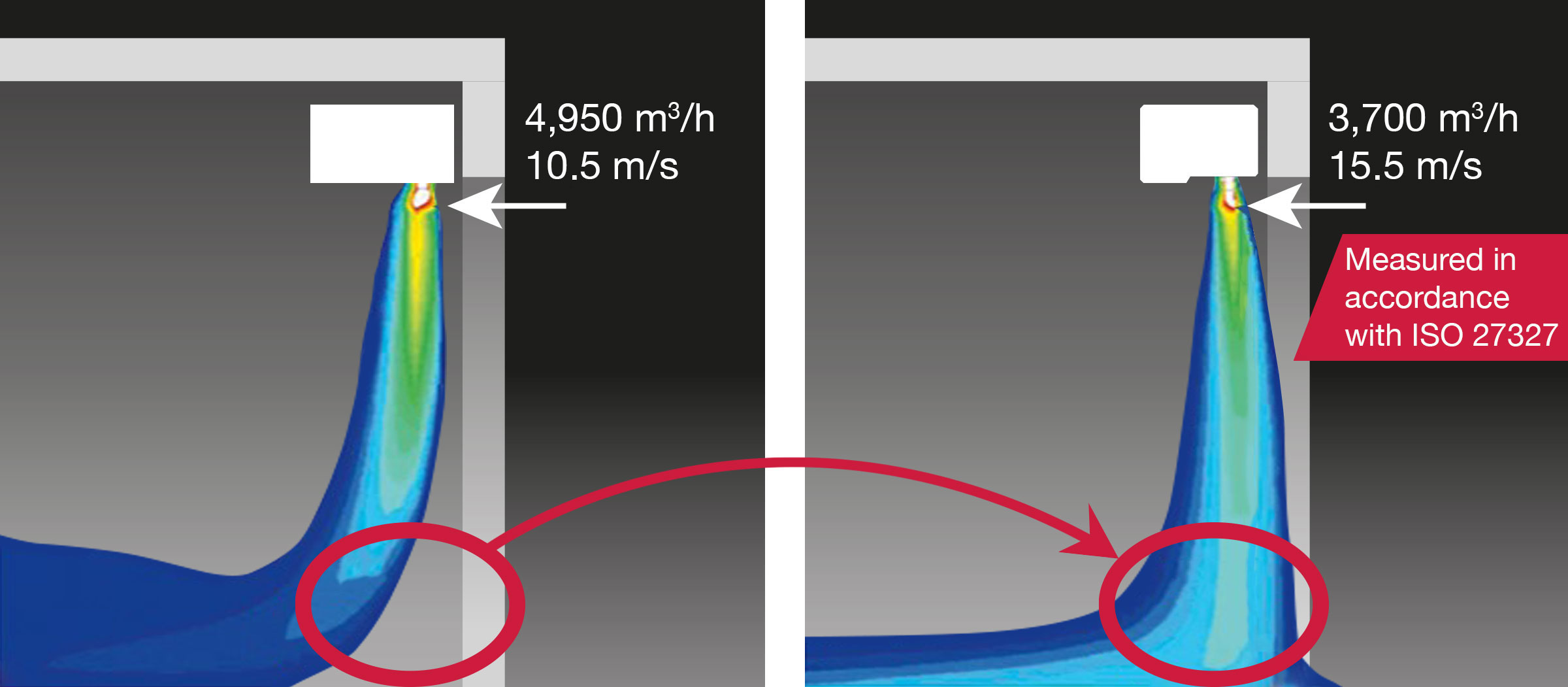
Comparison of a conventional air curtain (left) with a Teddington air curtain featuring the CONVERGO® pressure chamber nozzle system (right). Due to the higher discharge velocity, Teddington air curtains require a lower air volume. The nozzle design reduces turbulence and creates a stable air stream that reaches the floor.
Are air curtains worthwhile? Benefits at a glance
An air curtain installation will often pay for itself within a few years. Its primary benefits are the potential reduction in operating costs and improved conditions for employees, customers and visitors.
| Benefit | Effect | Applications | Impact |
|---|---|---|---|
| Reducing energy losses | Reduces the loss of heating or cooling energy through an open entrance | Retail, logistics centres | Can reduce heating and cooling requirements and the associated energy costs. Depending on the energy system used, the associated CO₂ emissions may also be reduced. |
| Improved comfort | Reduces cold draughts around entrances and reception areas | Restaurants, hotels, supermarkets, industrial buildings, cruise ships | More comfortable conditions for employees, customers and visitors |
| Barrier against external influences | Helps to reduce the ingress of flying insects, dust, exhaust fumes and odours | Food production, bakeries, hospitals and other sensitive environments | Can reduce cleaning requirements, help protect sensitive products and improve conditions within the building |
| Reducing fog, frost and ice formation | Reduces the ingress of warm, humid air and can therefore reduce fog, frost and ice formation around doors, floors and evaporators. | Cold stores, freezer warehouses, food production, temperature-controlled logistics | Reduced icing can lower defrosting requirements, improve operational reliability and reduce maintenance requirements |
| Reducing the spread of odours and dust | Reduces the spread of odour- or dust-laden air to the outside | Recycling facilities, waste management facilities, industrial buildings | Reduced impact on the surrounding environment |
Why air curtains are important for modern buildings
Energy performance requirements for buildings are becoming increasingly demanding. To reduce a building’s energy requirements, heat losses through the building envelope need to be kept as low as possible. Frequently opened doors can result in considerable energy losses, reducing the benefits achieved through a well-insulated building envelope.
Teddington air curtains can be integrated into modern heating concepts and connected to low-temperature heating systems such as heat pumps. The available flow temperature can be used to temper the discharged air. By reducing heat losses through open doors, an air curtain can help to reduce the building’s heating requirements.
A key factor is Teddington’s patented CONVERGO® pressure chamber nozzle system. Its specially developed nozzle technology produces a stable, precisely directed air stream that reduces the exchange of warm and cold air through open doors. Air curtains with CONVERGO® technology require around 30% less heating capacity than comparable conventional air curtains with air guide vanes.
How different applications benefit from air curtains
Air separation requirements vary considerably between different buildings and applications. Teddington air curtain systems can therefore be configured to suit the specific operating conditions.
To determine the potential energy savings for a specific building, a project-specific calculation is recommended. Door dimensions, opening times and temperature differences are among the factors that influence the potential savings. Use our energy savings calculator to estimate the potential for your particular entrance situation.
Why choose Teddington air curtains?
Planning guide: what to consider when choosing an air curtain
The air curtain needs to be correctly sized for the physical conditions at the entrance. If the system is undersized, outside air can penetrate the air stream. An oversized system, on the other hand, can use more energy than necessary.
- Measure the door width: The air stream needs to cover the entire width of the opening. For particularly wide entrances, several units can be installed side by side to create a continuous air barrier.
- Determine the installation height: The discharge velocity needs to be sufficient for the air stream to reach the floor. As the installation height increases, greater airflow performance may be required.
- Consider wind and pressure conditions: Exposed locations or buildings in coastal areas may require air curtain systems capable of operating under higher external wind loads. Negative pressure within the building, for example as a result of extraction systems, should also be taken into account.
-
Consider door opening frequency: The frequency and duration of door opening influence the selection and sizing of the air curtain. Permanently open or frequently used entrances can require a stronger air barrier.
- Select the heating option: Choose how the air curtain is to be supplied with heat. Depending on the system and application, options include connection to an LTHW heating system, electric heating or ambient operation without heating.
- Define the control requirements: Automatic controls can adjust fan speed and heating output according to the operating conditions and indoor and outdoor temperatures. This allows the air curtain to operate according to the actual requirements of the entrance.
Project-specific sizing by Teddington specialists
The required performance of an air curtain depends on numerous factors, including the door dimensions, installation height, wind conditions and pressure conditions within the building. Teddington specialists analyse these factors and size the air curtain system for the specific application.
This provides an air curtain solution matched to the individual installation conditions, with the aim of achieving reliable air separation and demand-based, economical operation.
Based on your requirements, we can also provide an individual, no-obligation quotation including an energy savings calculation.
How much energy could you save with a Teddington air curtain?
Explore control options for Teddington air curtains, from basic controllers to automatic operation and BMS integration.
How can we help with your project?
Tell us about your requirements using the contact form. Fields marked with * are required.
- Air discharge system: CONVERGO® pressure chamber nozzle system
- Air discharge range:
- Mounting position:
- Application:
- Shape:
- Heating options:
- Sound insulation:
- Unit length: Custom unit lengths available
- Fan type: AC